Chorus One is now a part of Bitwise. Bitwise is a global, crypto-first asset manager with $11 billion+ in client assets and a diverse suite of investment solutions. Learn more about how Chorus One is growing as a part of Bitwise at onchain.bitwiseinvestments.com.
Market Making, propAMMs, and Solana Execution Quality Landscape
In The Road to Internet Capital Markets, core Solana contributors outline a vision in which the network becomes the venue for global asset trading, defined by best prices and deepest liquidity. The main claim is that decentralized markets can absorb information from anywhere in the world in near real time. With Solana’s planned multi-leader architecture, or multiple block producers operating in parallel, the network can, in principle, reflect region-specific news faster than geographically concentrated TradFi venues.
Market Making, propAMMs, and Solana Execution Quality Landscape
Rafal Klich
December 19, 2025
•
18 min read
December 19, 2025
•
5 min read
TL;DR
Solana’s Internet Capital Markets vision depends on execution quality, the same metric that defines competitiveness in TradFi, measured through effective spreads and adverse selection.
TradFi wholesalers such as Citadel and Virtu typically deliver sub-1 bps spreads on liquid large caps and single-digit bps on mid-caps.
On Solana, classic AMMs (Orca, Raydium, Meteora) deliver 5-9 bps on SOL and 8-10 bps on BTC for small clips, but spreads widen quickly with size due to fee tiers and liquidity depth.
Prop AMMs (Humidifi, SolFi, Tessera, Zerofi) behave like on-chain market makers, quoting sub-1-5 bps on SOL, 2-4 bps on BTC, and sub-20 bps on TRUMP.
For sub-$100k trades, Solana’s leading prop AMMs now match TradFi execution quality. The remaining gaps at larger sizes reflect balance-sheet scale, not microstructure limitations.
With prop AMMs setting quotes and aggregators optimizing routing, Solana is already delivering pockets of TradFi-grade execution. It’s an early step toward the Internet Capital Markets vision.
Introduction
In The Road to Internet Capital Markets, core Solana contributors outline a vision in which the network becomes the venue for global asset trading, defined by best prices and deepest liquidity. The main claim is that decentralized markets can absorb information from anywhere in the world in near real time. With Solana’s planned multi-leader architecture, or multiple block producers operating in parallel, the network can, in principle, reflect region-specific news faster than geographically concentrated TradFi venues.
While Solana can offer a global latency advantage, speed alone is not sufficient for market dominance. What ultimately determines competitiveness is execution quality, the true cost of a trade relative to the asset’s fair price. Execution quality can be measured via:
Effective spread (what is the price for the taker).
Adverse selection (whether prices move against you immediately after execution).
Understanding these is essential because execution quality is fundamentally about market making. How liquidity is provided, how makers manage inventory, and how they protect themselves from informed flow. In TradFi, these mechanics are handled by wholesalers like Citadel and Virtu. On Solana, they are increasingly managed by proprietary AMMs (prop AMMs) that operate as onchain market makers.
This article gives a practical introduction to market making on Solana:
How execution quality is measured in TradFi (Rule 605).
How Solana AMMs, classic and prop, map onto those concepts.
What the current execution landscape onchain looks like.
Why Execution Quality Matters
Markets function only when participants can trade size with limited price impact. Liquidity depends on confidence. Market makers supply it by continuously quoting both sides, but they will only do so if they expect to survive contact with informed flow. When they’re repeatedly “picked off”, selling before prices rise or buying before they fall, they widen spreads or withdraw entirely.
Execution quality, therefore, is about building an environment where liquidity providers can quote tightly without being punished for doing so. This is why the ICM roadmap emphasizes mechanisms that protect market makers even if that slows price discovery.
A venue can be global, fast, and permissionless, but if execution is consistently worse than in TradFi, the ICM vision collapses. Conversely, if Solana can match or exceed TradFi’s execution quality, the case for permissionless global markets becomes irrefutable.
Execution quality is the determinant of market competitiveness. For retail, wider spreads led to worse fills, which in turn gave rise to Payment for Order Flow (PFOF) models such as Robinhood’s (Levy 2022). For institutions, a few basis points equate to millions in annual execution costs. In DeFi, wider spreads translate into higher swap costs and declining crypto user retention. Traders focus on venues where all-in execution costs are lowest and most predictable.
To understand how Solana can compete, we adopt a formal, data-driven framework. The global standard for measuring execution quality remains the one enforced by the U.S. SEC, codified in SEC Rule 605.
Execution Quality in TradFi
Market Structure Context
Modern U.S. equity markets are fragmented across exchanges, wholesalers, and alternative trading systems. The regulatory anchor is the National Best Bid and Offer (NBBO), which aggregates the tightest bids and asks from all lit exchanges at a given moment.
Retail investors rarely interact with those exchanges directly. Instead, their brokers (Robinhood, Schwab, Fidelity) route orders to wholesale market makers such as Citadel, Virtu, and Jane Street. These firms internalize the flow, providing price improvement relative to NBBO and, in return, paying the broker under PFOF arrangements. Market makers want to trade against retail because it is less informed, and they are willing to subsidize brokers to access that flow.
Institutional investors, by contrast, interact more often on exchanges or dark pools, where execution quality is worse, liquidity is thinner, adverse selection risk is higher, and spreads are wider, a structural disadvantage compared to wholesaler-handled retail flow (Zhu, 2014). This segmentation creates two very different execution experiences:
Retail: low (sometimes sub-basis point) costs on liquid names, hidden in the PFOF model.
Institutional: higher costs due to adverse selection, especially in mid- and small-cap stocks.
Measurement Framework (SEC Rule 605)
The SEC mandates monthly disclosures under Rule 605 to bring transparency into execution quality. These reports require wholesalers and exchanges to publish detailed statistics on how retail orders were executed.
These statistics include effective spread, which is a canonical metric, defined as twice the absolute difference between the execution price and the NBBO mid, expressed in basis points:
This measure is a round-trip comparable. The ×2 convention assumes that a one-way trade should be evaluated as half of a full buy-sell round trip.`
Rule 605 also reports realized spread, which compares the execution price to the midpoint shortly after execution. It measures adverse selection, or whether the price moved against the liquidity provider after filling the order:
Positive realized spreads imply the order flow was uninformed. Negative values mean the market maker was picked off, indicating toxic flow.
In this article, we will focus on presenting effective spreads.
Effective Spreads in U.S. Equities
To ground execution quality in data, we analyzed SEC Rule 605 reports across wholesalers and aggregated marketable orders to estimate effective spreads in basis points relative to traded notional size.
Source: SEC Rule 605 September 2025 filings Citadel, Virtu, Jane Street. Dune.
Figure 1: TradFi effective spreads (bps) vs. USD notional size
Execution quality in US equities scales sharply with both liquidity and trade size.
In benchmark stocks like SPY or AAPL, spreads remain below 1 bp even for multi-million-dollar trades.
As size increases, costs widen gradually into the 1–5 bp range in META, TSLA, and HOOD.
Thinner names, such as COIN, can exceed 10 bps for sub-million-dollar clips.
Spreads widen with trade size relative to available liquidity. In traditional markets, a price curve emerges organically from the balance between a market maker’s inventory constraints and the risk of trading against informed flow. Each incremental unit of size consumes balance sheet and increases adverse selection exposure, steepening the effective cost.
This behavior is not unique to TradFi. Onchain markets obey the same logic. Legacy AMMs aim to approximate this relationship mechanically by using deterministic pool curves rather than adaptive inventories. Prop AMMs on Solana, by contrast, collapse that abstraction entirely. They are market makers in the traditional sense, quoting prices based on inventory, risk, and order-flow information.
AMM Architecture on Solana
Classic AMMs
Classic AMMs, such as constant-product and concentrated liquidity, no longer dominate Solana’s volume, but they still underpin much of the onchain market structure. Their design remains the reference point for decentralized execution quality.
Constant-product AMMs distribute liquidity uniformly along the price curve, ensuring continuity but leaving most capital idle and spreads structurally wide. Concentrated liquidity AMMs address this inefficiency by allocating liquidity more tightly around the active price, improving capital efficiency and near-mid execution.
Prop AMMs
Proprietary automated market makers are a Solana-native innovation. They follow the same deterministic settlement rules as classic AMMs, but replace their curve-based pricing logic with model-based quoting.
Figure 2: Share of Solana DEX volume by pool type. Prop AMMs now account for roughly 65% of on-chain trading volume, surpassing traditional CLAMMs.
Instead of encoding liquidity as a fixed function of reserves, a prop AMM computes executable quotes from a live strategy that reflects inventory, volatility, and hedging across markets.
Structurally, a prop AMM behaves like an onchain quoting engine connected to an offchain risk model.
It holds a pool or vault of assets that represent its trading inventory.
The program queries a pricing model that determines the best bid and ask consistent with its current exposure.
These quotes are deterministic, fully auditable onchain, but they can change every block, allowing the AMM to adjust to market data in near-real time.
This design eliminates the inefficiency of passive CLAMMs, in which LPs continuously provide liquidity on both sides of a curve and incur impermanent loss.
Prop AMMs quote **when their internal model deems the trade safe or profitable. Pricing is rewritten after each fill, redrawing the curve around the new inventory position. As a result, execution quality depends on model precision, update latency, and inventory limits.
The rise of prop AMMs on Solana marks a transition from curve-based liquidity to TradFi-like quote-based execution, only without custodial intermediaries.
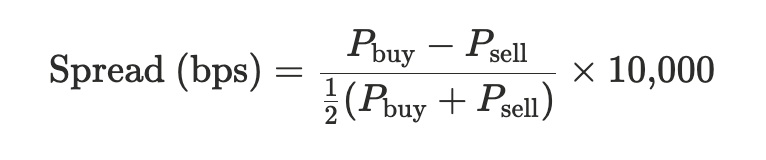
To evaluate Solana’s ICM vision, we adapt Rule 605's logic to on-chain data. DeFi lacks a true NBBO because AMMs do not publish standing bids and asks. Instead of quote-based spreads, we infer execution quality directly from realized trades.
We group all executions within the same Solana slot and compute volume-weighted average buy and sell prices for each venue. Their difference represents the realized bid–ask width implied by actual trading activity at that moment:
Equation 3: Effective spreads onchain
Aggregating these slot-level values into volume-weighted averages gives a venue-level execution metric directly comparable to TradFi spreads. While this diverges from the NBBO-based definition, which uses public quotes rather than trades, the underlying economic interpretation is the same: the round-trip cost of immediate liquidity.
This framework allows us to measure how efficiently Solana’s DeFi venues deliver execution, expressed in the same units used for equity markets. We apply it to both classic AMMs and proprietary AMMs.
SOL–USDC
SOL is the deepest and most competitive market on Solana, making it the clearest choice for comparing AMM designs. The market has become increasingly crowded, with multiple venues active across the entire size ladder. Humidifi leads with almost 65% of SOL–USDC volume recently.
Figure 3A. SOL–Stablecoin DEX volume by venue (Blockworks Research, 2025).
Execution on SOL–USDC is uniformly strong across all AMM types, but venue-specific patterns emerge when trades are grouped by notional size.
Across all trade sizes, from 100 USD up to 1M USD, prop AMMs (HumidiFi, Tessera, ZeroFi, SolFi, GoonFi) sit at the front of the spread distribution. Their defining feature is size invariance, meaning spreads barely change as trade size increases.
HumidiFi quotes 0.4–1.6 bps across nearly the entire size ladder, only increasing to 5 bps at $1M. Tessera and ZeroFi cluster in the 1.3–3 bps range, maintaining these results even at 100k.
Pop AMMs set the lowest spreads on Solana and remain stable at scale.
For the bulk of flow ($1k-50k), they converge to a 5-9 bps band.
Raydium: ~1.7-6.5 bps
Orca + Meteora: generally 7-9 bps
Beyond ~$100k, spreads begin drifting upward with Whirlpool and Meteora widening more sharply as trades cross bins or consume depth.
Large clips ($500k-1M) often push spreads into double digits.
Orca remains the dominant venue by volume across all buckets above $50k.
BTC-USDC
In 2025, BTC liquidity on Solana cycles through several venues. Orca leads for most of the year, typically handling the largest share of weekly volume. Meteora remains the main secondary venue, with a steady but smaller footprint. Prop AMMs begin to matter as the year progresses: SolFi and ZeroFi start taking meaningful share from mid-2025 onward, and Humidifi emerges later with growing market share.
Figure 3B: Bitcoin DEX volume by venue (Blockworks Research, 2025).
BTC execution mirrors the SOL patterns but with more noise due to thinner depth. Prop AMMs dominate the low end of spreads, while classic AMMs widen more quickly with size.
Humidifi is the only prop AMM with consistent BTC flow and quotes 2–4 bps across all trade sizes, with minimal size dependence.
SolFi shows thinner inventory:
6–12 bps for small trades
20–47 bps for $50k+ clips, reflecting a still-developing quoting model.
ZeroFi lands between the two, starting around 1–2 bps for small clips and rising into the 6–12 bps range for mid-sized trades.
Figure 4B: Effective spreads (bps) by trade-size bucket across BTC AMMs. Bubble area proportional to traded volume.
Classic AMMs remain less competitive compared to propAMMs on BTC:
Orca anchors BTC execution at ~8 bps for small and mid-sized trades, rising to 9–10 bps above $50k as size increases.
Meteora DLMM steepens quickly: 8–9 bps at $1k–$5k, but 15+ bps by ~$10k.
PancakeSwap posts 2–3 bps on small pools due to very low fees, though depth is shallow.
Overall, prop AMMs set the tightest BTC spreads, while classic AMMs account for most of the trading volume, but at higher and more size-sensitive costs.
TRUMP-USDC
TRUMP is a useful benchmark for meme execution. Its liquidity is large enough (including a ~$300M DLMM pool) to behave like a mid-cap, yet volatile enough to stress AMM pricing models. Spreads are an order of magnitude wider than in SOL or BTC, but the relative performance across AMM types remains informative.
Prop AMMs again show flexible but not dominant pricing:
Humidifi: 11–16 bps for mid-sized trades, slightly tighter at $10k–$50k
SolFi: occasionally efficient (~7 bps), but with high variance (20–26 bps)
Zerofi: stable performance at smaller sizes with 11–18 bps
Prop AMMs do not dominate TRUMP execution the way they do in SOL.
Figure 4C: Effective spreads (bps) by trade-size bucket across TRUMP AMMs. Bubble area proportional to traded volume.
Classic AMMs cover most TRUMP execution with Meteora quoting 20–25 bps across almost all sizes, a profile tied directly to its fee floor as trades stay within a single, huge liquidity bin of the aforementioned pool.
What the Data Shows
Execution quality on Solana is no longer constrained by AMM mechanics, but by balance-sheet scale and risk tolerance.
Classic AMMs behave as their design predicts. Fees and liquidity placement impose a spread floor, while limited depth causes execution costs to rise nonlinearly with trade size. Outside of SOL, these venues still carry most of the flow, but only by accepting higher and more size-sensitive execution costs.
Prop AMMs, by contrast, show the characteristics of true market makers. Their spreads are tighter and largely invariant to size across a wide range, showing that pricing is driven by inventory and risk limits rather than fixed curves.
This difference points to the remaining execution gap. Where Solana underperforms TradFi, the cause is primarily capital scale. TradFi wholesalers compress spreads at multi-million-dollar sizes by deploying massive balance sheets and internalizing flow across venues. On Solana, comparable execution quality already exists, but only up to the inventory limits of today’s prop AMMs.
With that framing, the implications for Solana’s Internet Capital Markets vision become clear.
Conclusion
Prop AMMs define the execution frontier. They deliver sub-1–5 bps spreads on SOL with minimal size dependence; on BTC, Humidifi anchors execution at 2–4 bps; and even on volatile tokens like TRUMP, prop AMMs are the only venues able to break below the 20–25 bps floor imposed by fees in substantial Meteora’s liquidity pools. Their performance comes from market-maker–style quoting: inventory-aware, model-driven, and updated on top of every block.
Classic AMMs show a more size-sensitive regime. SOL pairs cluster around 5–9 bps for typical flow; BTC spreads widen sharply at higher notionals; and TRUMP prices settle near the fee floor. They provide the liquidity backbone, but not the best execution.
Compared to TradFi, Solana is increasingly competitive for small and mid-sized orders.
Rule 605 data places S&P-500 names in the sub-1–8 bps range, mid-caps in the 3–25 bps range. Prop AMMs already match or exceed this for sub-$100k trades, especially in the native SOL markets. The remaining performance gap stems from scale: TradFi exchanges achieve execution quality even for orders of $ 1M+.
In short, prop AMMs have brought true market making on-chain. They have shown the path forward: a quote-driven, inventory-aware model that, when combined with increasingly sophisticated routing, will define how the Internet Capital Markets vision ultimately comes to fruition.






.png)
.png)
.png)
.png)
.png)
.png)
.png)