Stay vigilant against phishing attacks. Chorus One sends emails exclusively to contacts who have subscribed. If you are in doubt, please don’t hesitate to reach out through our official communication channels.
Chorus One is now a part of Bitwise. Bitwise is a global, crypto-first asset manager with $11 billion+ in client assets and a diverse suite of investment solutions. Learn more about how Chorus One is growing as a part of Bitwise at onchain.bitwiseinvestments.com.
Lido Vault Strategies Explained: How Lido v3 Unlocks Institutional-Grade Staking and DeFi
Mikal Sande
February 2, 2026
•
10 min
5 min read
February 2, 2026
•
5 min read
Lido v3 represents the most meaningful architectural shift in Lido’s history. Rather than simply improving liquid staking mechanics, it introduces a modular vault-based framework that fundamentally reshapes how staking interacts with DeFi. For institutions in particular, Lido v3 opens the door to configurable staking, operator choice, and native integration with on-chain strategies, all while preserving custody and control.
At Chorus One, we have been exploring the Lido v3 architecture, including building a proof-of-concept leveraged staking strategy using Morpho. This article is a technical walkthrough of Lido Vault Strategies: how they work, why they matter, and what they unlock for sophisticated stakers.
From Liquid Staking to Vault-Based Architecture
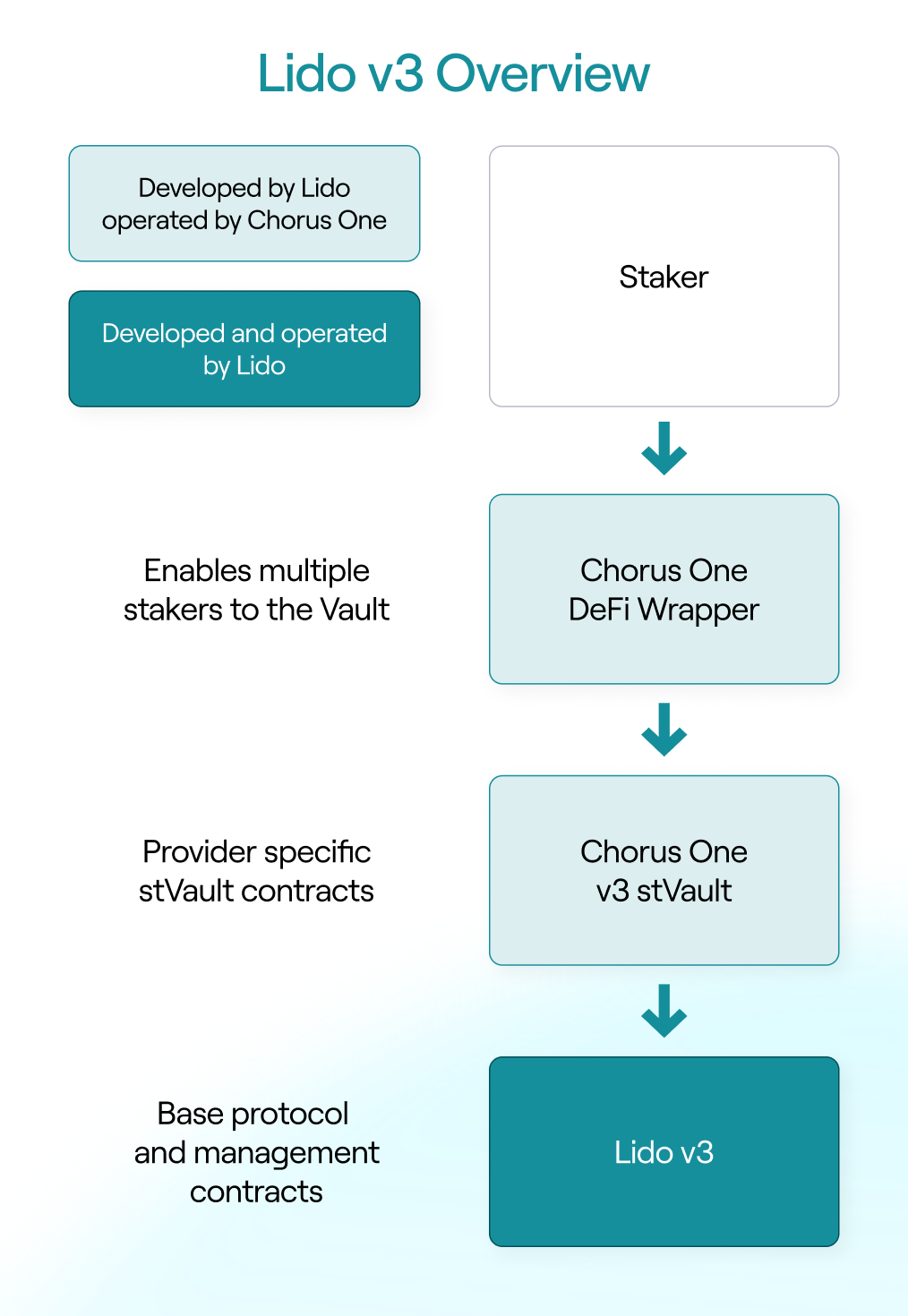
Lido v3 introduces stVaults, a new primitive that decouples staking infrastructure from token issuance and DeFi usage. At a high level, Lido v3 complements Lido Core Protocol with a layered architecture composed of three core components..
At the base is the Lido v3 protocol itself, which handles validator management, accounting, and withdrawals. On top of that sits the stVault, a vault contract deployed and operated by a specific node operator. Importantly, each stVault accepts stake from a single address only – a deliberate design choice that enables operator selection and simplifies accounting.
To enable multiple users to access the same vault, Lido introduces a DeFi Wrapper. This wrapper aggregates deposits from many users and interacts with the stVault on their behalf. When no strategy is applied, users can stake through the wrapper and receive staking exposure without any additional DeFi logic.
Why stVaults Matter for Institutions
The shift to stVaults is not just a technical upgrade – it is a structural change that directly addresses institutional requirements.
First, stVaults allow stakers to choose their staking partner. Unlike today’s pooled Lido model, where stake is distributed across operators by the protocol, institutions using stVaults can
Explicitly select the validator they trust and align with their compliance and operational requirements.
Second, Lido v3 enables staking without minting. Institutions are no longer forced to hold liquid staking tokens on their balance sheet, eliminating accounting and custody complications while retaining full staking exposure.
Third, when minting is desired, vaults support direct minting of wstETH, removing the need for additional swaps before entering DeFi. This small design choice has meaningful implications for efficiency, gas costs, and operational simplicity.
Finally, stVaults introduce a clean interface for custom staking strategies, enabling staking and DeFi interactions to be composed into a single, auditable workflow.
What Are Lido Vault Strategies?
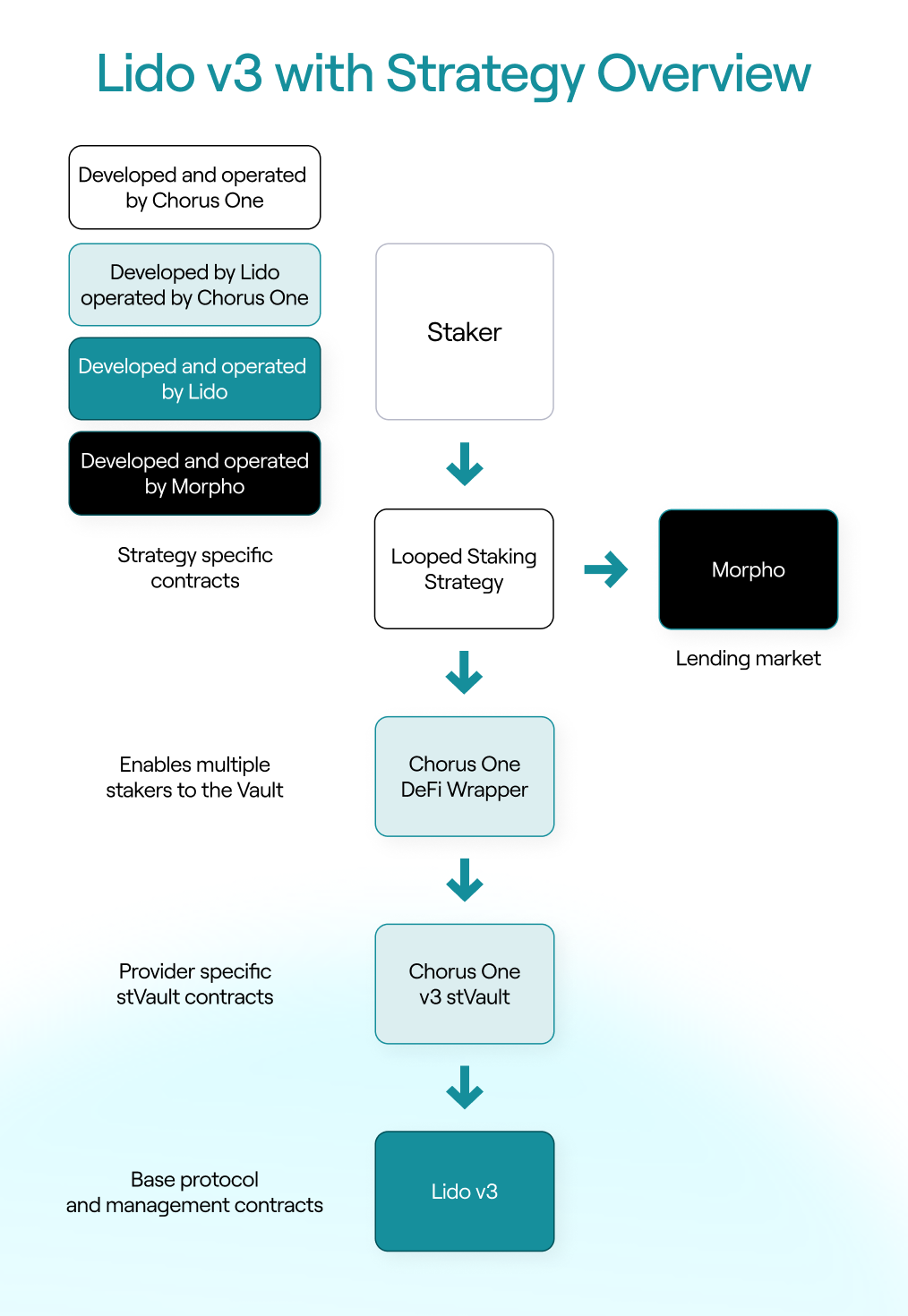
Lido Vault Strategies are optional smart contract layers placed in front of the DeFi Wrapper. Instead of interacting with the wrapper directly, users interact with the strategy contract, which orchestrates staking, minting, borrowing, and rebalancing logic on their behalf.
This design allows users to access additional on-chain opportunities, such as lending, liquidity provision, or structured yield strategies, without managing multiple contracts or transactions
themselves. Importantly, strategies are not required: a vault can operate purely as a staking vehicle. When added, however, strategies become the mechanism that enables more advanced capital usage while preserving Lido’s core security guarantees.
Connecting Staking to DeFi: Why This Matters Now
One of the most important implications of Lido v3 is how it simplifies connecting staking to existing DeFi venues. Protocols like Morpho have become key on-chain destinations for capital, including for crypto-native funds and increasingly for TradFi-linked participants seeking lending and borrowing exposure using assets like USDC.
What these venues generally lack is direct access to staking. Large financial institutions are comfortable with lending and collateralized borrowing, but staking remains unfamiliar territory.
Lido Vaults change this dynamic. By starting upstream with staking and flowing downstream into DeFi, vault strategies provide a natural bridge: participants already active in lending markets can begin to understand staking not as a separate activity, but as an integrated source of yield and collateral. Over time, this structure lowers the conceptual barrier to staking for institutions that otherwise would not engage with it directly.
Leveraged Staking on Lido v3: A Technical Exploration
To understand the practical implications of Vault Strategies, Chorus One built an early-stage proof-of-concept leveraged staking strategy using Lido v3 and Morpho.
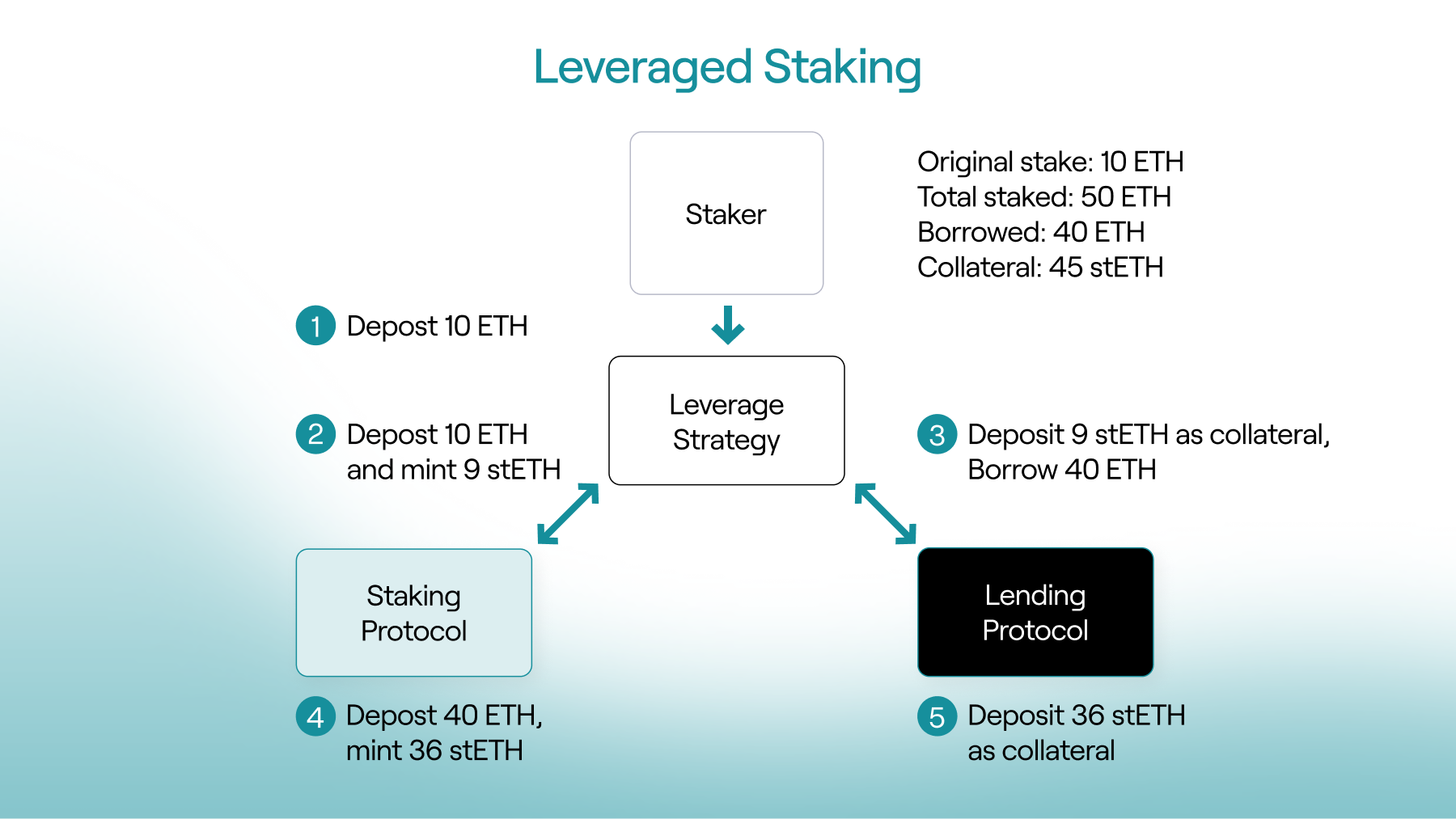
What is leveraged staking? Leveraged staking involves borrowing ETH against staked collateral (wstETH) and restaking the borrowed ETH to amplify staking rewards. Traditionally, this requires looping: stake, mint, borrow, restake. Lido v3 however, enables a far cleaner, less complex approach.
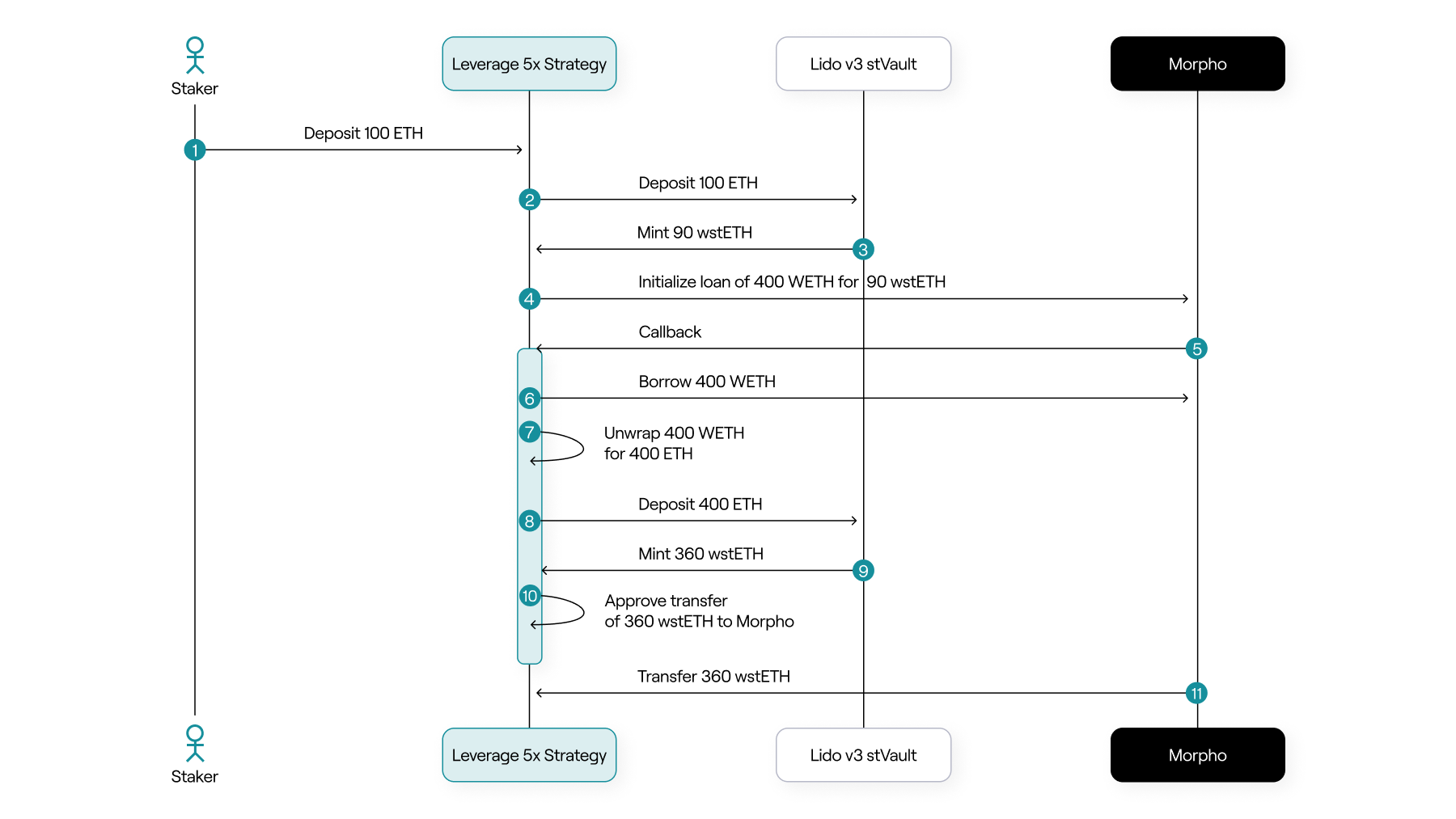
Using a strategy contract and Morpho’s callback architecture, we were able to design a flow where users can enter a leveraged position in a single transaction, at any target leverage level, without looping. Gas costs remain constant regardless of leverage, and contract complexity is reduced significantly.
Equally important is the exit path. One of the hardest problems in leveraged staking is unwinding positions during withdrawals. Lido v3 introduces a withdrawal-with-rebalancing feature that allows the loan to be repaid and the withdrawal to be requested in the same transaction. This means positions can be unwound immediately, without waiting days in the withdrawal queue while a loan remains outstanding.
From a technical perspective, this combination – strategy contracts, Morpho callbacks, and Lido’s rebalancing withdrawals – makes leveraged staking both capital and operationally more efficient than previous designs.
Engineering Is Only the Starting Point
Building the strategy contract itself was feasible using largely off-the-shelf components. Lido v3 is highly composable by design, the rebalancing feature, and Morpho’s callback architecture significantly simplifies both entry and exit flows.
Simplified diagram, assumes wstETH/ETH is 1:1.
However, the most important lesson was that contract development is only a fraction of the work required to build an institutional-grade vault strategy.
Robust products require published risk analysis covering every protocol and asset involved, risk controls embedded directly into contracts and operational workflows, thoughtful financial structuring for downside protection, real-time monitoring with alerting and emergency procedures. They also require active financial operations, including fund rebalancing and emergency unwinds when market conditions demand it.
Recent DeFi vault failures have shown that technical sophistication alone is insufficient. Many curators can build contracts that work when conditions are favorable, but lack the risk discipline needed to operate through stress events. This is where infrastructure providers must differentiate themselves.
Why This Matters for Lido and Its Operator Set
Lido v3 stVaults are not just a new staking interface — they are an invitation for operators to step into an active role with more visibility and responsibility. Operators are no longer anonymous infrastructure providers; they become integral participants in how staking and DeFi strategies are designed, operated, and risk-managed.
For Chorus One, this aligns closely with how we already operate across other ecosystems. As a SOC 2-compliant, ISO 27001-certified provider based in Switzerland, we see Lido v3 as a natural evolution of institutional staking rather than a departure from it.
Looking Ahead
Lido v3 stVaults are expected to launch in 2026. When they do, staking will no longer be a terminal activity: it will be the first step into programmable, risk-managed DeFi strategies that can be accessed in a single transaction.
DeFi is going institutional, and that transition starts with staking. With Lido v3, users no longer need to choose between staking yield and DeFi participation. They can have both – cleanly, transparently, and with operator accountability.
At Chorus One, we are excited to bring these strategies to market, beginning with public vaults and expanding to private, customized deployments. If you are interested in exploring Lido Vault Strategies or learning how they can be tailored to your needs, we would be glad to continue the conversation.
Link copied!
Join our mailing list to receive our latest updates, research reports, and industry news.
Thanks for subscribing. Watch out for us in your inbox.
Oops! Something went wrong while submitting the form.