As corporate treasury strategies evolve beyond Bitcoin, a new era is emerging, where crypto assets are not only held but put to work. In our previous piece, Treasury 3.0: How Digital Asset Treasuries Are Turning Crypto into Yield, we explored how companies began expanding from BTC reserves into yield-generating assets like Ethereum and Solana through staking. Now, as more treasuries adopt active on-chain strategies, including restaking, liquid staking, and DeFi integrations, the pressure is mounting to match these innovations with enterprise-grade reporting. Tracking rewards across dozens of chains, validators, and wallets is a strategic imperative. Without robust, auditable reward data, even the most promising digital treasury strategy can become a liability.
As treasuries shift from passive holding to active reward generation, accurate reporting becomes a key requirement. Every staking reward, restaking payout, or MEV gain constitutes taxable income, potentially with varying fair market values, and protocol-specific nuances. Without a robust system to capture, timestamp, and reconcile these events, finance teams risk producing inaccurate financial statements or triggering red flags with auditors and regulators. The challenge compounds with multichain exposure: fragmented wallets, inconsistent reward structures, and untracked validator commissions all introduce operational noise. High-quality reporting is how treasury teams ensure they’re maximizing yield opportunities, maintaining audit readiness, and preserving institutional trust with stakeholders.
So what defines treasury-grade crypto reporting? It starts with multi-chain coverage and accurate, granular data: daily attribution of rewards, including staking yields, restaking payouts, and MEV income, mapped to the specific wallet, validator, and protocol that generated them. Institutions also need visibility into validator commissions, service fees, and any slashing events that affect net returns. As many treasuries segment assets by fund, business unit, or jurisdiction, reporting must support wallet-level granularity and entity-specific tagging. Just as important is the format: data must enable seamless integration into back office systems, and ultimately align with GAAP or IFRS standards as digital assets are formally recognized in financial reporting frameworks. Fair market value (FMV) at the time of reward is a critical enhancement that enables compliance with IRS Revenue Ruling 2023-14 and emerging EU tax rules under DAC8. Without these capabilities, crypto reporting falls short of the institutional bar.
Consider the journey of a typical corporate treasury evolving its digital asset strategy. In the early phase, the fund holds BTC, tracked through simple ledger tools or custodial statements. But as it adds ETH and begins staking ETH, complexity creeps in. Rewards accrue on-chain, commissions may vary, and new wallets emerge for each protocol. By the time the finance team embraces restaking strategies through EigenLayer or allocates to DeFi vaults, its treasury operations involve dozens of addresses, multiple chains, and a constant stream of taxable events. Without a unified reporting system, the result is fragmented data, error-prone manual reconciliation, and an unreliable audit trail. In contrast, Chorus One’s Rewards Reporting tool provides a single source of truth: dashboards tracking staking and reward activity across multiple chains, daily performance summaries, and downloadable reports ready for fund administrators, auditors, and tax professionals. It enables crypto treasuries to scale with confidence, knowing their yield strategies are matched with enterprise-grade transparency.
Chorus One’s Rewards Reporting is designed to meet the operational and compliance demands of modern crypto treasuries. Its validator monitoring tools allow finance and ops teams to track uptime, reward rate consistency, and restaking activity across 20+ supported protocols, without needing to rely on explorers or raw chain data. Every staking reward is calculated with precision, accounting for validator commissions, service fees, and available rebates to ensure accurate net attribution. And reports can be exported in Excel or CSV formats for seamless integration into existing back off systems ready for accounting systems, fund administrators or auditors.
As crypto treasuries evolve to embrace staking, restaking, and DeFi strategies, the infrastructure that supports them must evolve as well. Sophisticated digital asset strategies demand equally sophisticated reporting tools that deliver precision, transparency, and compliance at scale. With its reporting tool, Chorus One equips institutional teams with the visibility and structure needed to turn raw on-chain activity into actionable financial intelligence. Whether you're optimizing validator performance, preparing for an audit, or reconciling yield across a global treasury, Chorus One ensures that your reporting is as productive and reliable as the assets it supports.
A recent proposal from HOTDAO and LiNEAR went live, it suggests cutting NEAR inflation in half. from 5% to 2.5%, which would reduce the annual staking rate to ~4.75% assuming the same staking ratio.
Chorus One has been a validator on NEAR for ±2 years, and one of the most active in terms of governance in PoS networks. We wanted to share some thoughts and feedback around the proposal and its implications for various ecosystem participants. In summary, we acknowledge the motivation and some of the benefits behind reducing base staking rewards, but our view is that the NEAR ecosystem is still too nascent to implement such a drastic change without sufficient time for community discussion. We suggest alternative measures that work towards the same goal, and welcome open feedback from the community.
The primary motivation behind, as stated in the proposal, is to move towards more sustainable economics, as well as incentivizing DeFi participation on NEAR. We previously conducted a similar analysis on SIMD228 and found no definitive conclusion on TVL elasticity towards inflation. For newer ecosystems, this argument should be much weaker as the network has not reached a point where there's sufficient organic economic activity. NEAR’s top 3 LSTs, for instance, only have a combined 1.1% penetration rate.
Despite NEAR’s growth over the past years, the network’s fee generation remains modest relative to its inflation rate. The DeFi ecosystem, while promising, is still maturing and has yet to generate sufficient economic activity to offset a sharp reduction in staking rewards. This is in contrast to mature networks like Solana, which recently also had a proposal that failed to pass, discussing adjusting inflation to a variable rate based on staking participation, which lowers base inflation when staking rates are higher and vice versa. For context, the average monthly Real Economic Value (REV) on Ethereum in H2 2025 was approximately $69.53 million, and Solana averaged $181.8 million. In contrast, Near had around $1.6 million in fees generated, about 43× less than Ethereum and 114× less than Solana. Near’s annual staking reward rate would be lower than Solana’s despite having less economic activity and only marginally higher than Ethereum’s. We are concerned that this disparity could drive stakers to other ecosystems in search of higher rewards and economic activity, ultimately negatively impacting Near.
NEAR currently has 100 active validators proposing blocks, but the top 11 control 33% of the network’s stake. The proposed halving of staking rewards could disproportionately impact smaller validators leading to even more centralization, we’d like to see more initiative on how this would aim to be addressed before. It was mentioned that some modelling and calculations were done around this proposal, we’d love to see the numbers and analysis behind.
Rather than primarily cutting inflation and focusing on the supply side, fostering a vibrant ecosystem through liquid staking and incentivizing active chain usage and the demand side may be more effective. As aforementioned, despite a high inflation rate, LSTs only have 1.1% penetration, which could imply a lack of productive use cases in the ecosystem. Encouraging more on-chain activity and DeFi innovation can organically enhance token value and network health without risking validator attrition.
As the Tezos protocol evolves, so do our services. In response to the recent Paris upgrade, we’re updating how we operate our Tezos validator (aka Baker).
We will no longer support delegations to our Tezos validator.
TL;DR
Chorus One: tz1eEnQhbwf6trb8Q8mPb2RaPkNk2rN7BKi8 (Explorer)
Chorus One 2: tz1Scdr2HsZiQjc7bHMeBbmDRXYVvdhjJbBh (Explorer)Chorus One: tz1eEnQhbwf6trb8Q8mPb2RaPkNk2rN7BKi8 (Explorer)
For additional information on Delegating versus Staking your XTZ, visit Tezos Docs.
Need help? Contact staking@chorus.one.
Thanks for your continued trust, — The Chorus One Team
Chorus One and Hex Trust are thrilled to announce the expansion of their strategic partnership to unlock institutional access to Stacks (STX) staking, delivering the power of Bitcoin Layer-2 directly into regulated, secure custodial environments.
Unlocking Bitcoin’s Programmable Potential for Institutions
Through this integration, Hex Trust’s institutional clients can now stake STX and earn native Bitcoin rewards via Stacks’ innovative Proof-of-Transfer (PoX) mechanism, all within a fully compliant, bank-grade custody platform. This partnership brings together Hex Trust’s regulated custody expertise and Chorus One’s industry-leading staking infrastructure, empowering institutions to participate in the next evolution of Bitcoin DeFi with confidence.
Key Benefits for Institutional Clients
Why Stacks (STX) Staking Matters
Stacks is the leading Bitcoin Layer-2 protocol, enabling smart contracts and DeFi applications secured by Bitcoin. With STX staking (or “stacking”), institutions can:
How to Get Started
“This partnership is a significant milestone in bringing Bitcoin Layer-2 opportunities to institutional portfolios. By combining Hex Trust’s regulated custody with Chorus One’s secure staking infrastructure, we’re enabling clients to earn BTC rewards and participate in the next wave of Bitcoin innovation, all with the highest standards of security and compliance.” — Joint Statement from Hex Trust & Chorus One Leadership
About Hex Trust
Established in 2018, Hex Trust offers regulated institutional digital asset custody, staking, and markets services to builders, investors, and service providers. For more information, visit Hextrust.com or follow Hex Trust on LinkedIn, X, and Telegram.
About Chorus One
Chorus One is a global leader in institutional staking, operating secure infrastructure across 40+ Proof-of-Stake networks and managing over $2.5 billion in staked assets. With ISO 27001 certification and a track record of innovation, Chorus One empowers institutions to maximize returns and network participation.
Ready to unlock the future of Bitcoin DeFi?
Contact Hex Trust today and start staking STX with confidence.
Chorus One is thrilled to announce a major milestone for the TON community: Chorus One’s industry-leading TON Pool is now fully integrated within the SafePal Wallet, unlocking secure, simple and high-performance TON staking for millions of users worldwide.
Elevating TON Staking: SafePal x Chorus One
With this integration, SafePal users can now delegate their TON directly to Chorus One’s TON Pool underpinned by robust validator infrastructure without leaving the comfort and security of their SafePal Wallet. Whether you’re safeguarding assets on a hardware device or managing your portfolio via the SafePal mobile app, staking TON has never been easier or more secure.
Key Benefits
Why Chorus One for TON?
Chorus One has rapidly become the staking provider of choice for institutions and individuals seeking reliability, transparency, and top-tier performance. As the TON ecosystem continues its explosive growth driven by deep Telegram integration and a thriving developer community, Chorus One’s TON Pool is setting new standards for security and accessibility.
Highlights of Chorus One’s TON Pool:
Tutorial - How to Get Started


“Our mission is to make secure staking accessible to everyone, everywhere. Integrating with SafePal brings our trusted TON staking infrastructure to a global audience, empowering users to participate in network security and earn sustainable rewards all from a wallet they know and trust.”
— Brian Crain, Co-Founder & CEO, Chorus One
About Chorus One
Chorus One is a global leader in institutional staking, operating secure infrastructure for over 40 Proof-of-Stake networks, including Ethereum, Solana, Cosmos, Avalanche, and TON. Since 2018, Chorus One has delivered enterprise-grade staking solutions, industry-leading research, and a commitment to the highest standards of security and performance.
About SafePal
SafePal is a next-generation, non-custodial crypto wallet suite serving over 20 million users across 200+ countries. Backed by industry leaders, SafePal empowers users to manage, swap, and stake digital assets securely across 100+ blockchains all from a single, intuitive platform.
Ready to stake TON with confidence?
Open your SafePal Wallet and start earning with Chorus One today!
We’re excited to announce Ledger By Chorus One, a collaborative effort with our long-time partners, Ledger, to continue supporting network security and performance within the Cosmos ecosystem.
Previously, the Cosmos (ATOM) validator node was managed and operated directly by Ledger. With Ledger By Chorus, all operational responsibilities will now be handled by Chorus One, with the new name and Chorus One’s Terms of Service reflecting this transition.
✅ The COSMOS node is now called Ledger By Chorus One, operated by Chorus One.
✅ No interruptions to staking operations—your rewards will continue to accrue and will be claimable as usual.
✅ Chorus One’s Terms of Service will now apply instead of Ledger Live’s Terms of Use. This will have no impact on staking rewards or functionality. To review, click here.
Ledger has chosen Chorus One because of our proven track record securing over 60 proof-of-stake networks, including Cosmos, Ethereum, and Solana. Our ISO 27001-certified infrastructure, 24/7 monitoring, and redundant systems provide the reliability, security, and performance that Ledger—and its users—expect.
Together, we’re combining:
🔐 Ledger’s world-class hardware wallet security — keeping your private keys offline and protected.
⚡ Chorus One’s validator expertise — ensuring your staked ATOM earns consistent rewards with minimal downtime.
🚀 A streamlined staking experience — you can continue to stake and manage your ATOM directly within the Ledger Cosmos wallet, backed by Chorus One’s institutional-grade infrastructure and expertise.
Ledger by Chorus One builds on our history of collaboration and our shared commitment to secure, seamless staking experiences. To learn more about existing Ledger x Chorus One integrations, click here.
Nothing! Your stake stays right where it is, your rewards keep flowing, and you can manage your staking directly in Ledger Live. You can review the new terms and conditions here—please note that no action is required, and there is no time limit.
Should you not agree with the new terms, you may undelegate at any time. For additional details, see Ledger’s Cosmos staking guide here.
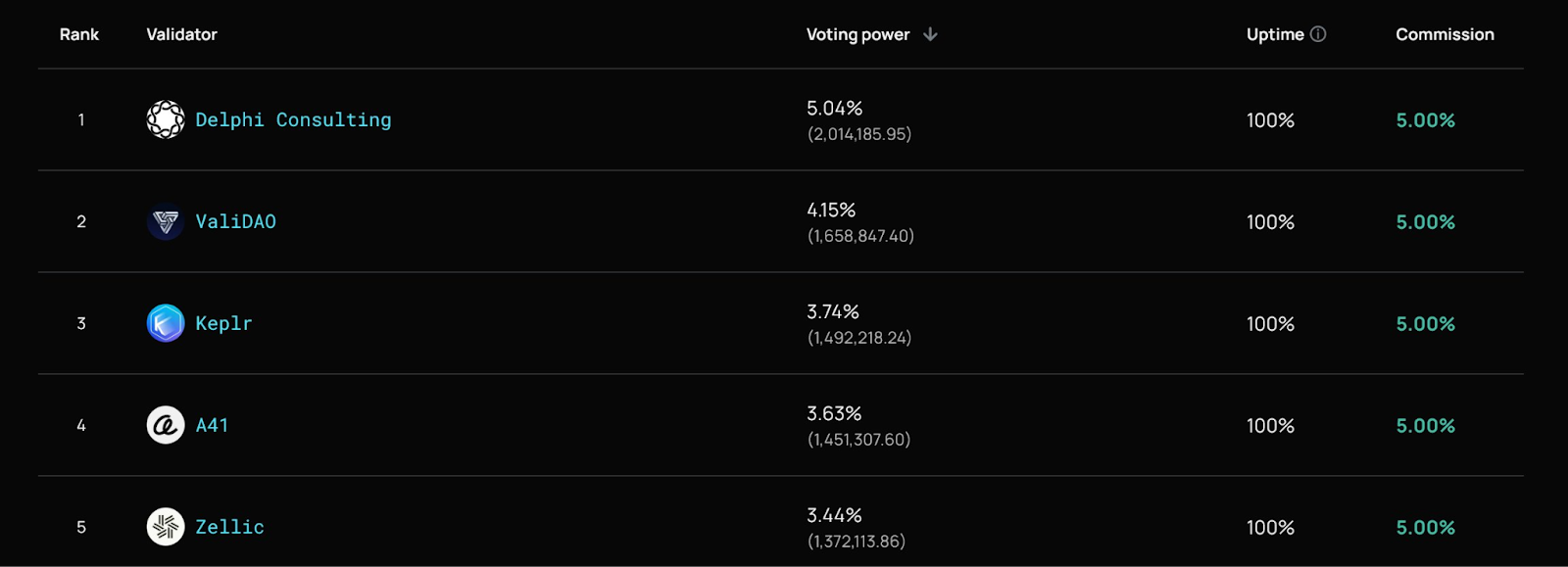
With ~6.63 million ATOM staked (worth over $30 million) and representing 2.63% of total voting power, Ledger By Chorus One remains a trusted cornerstone of the Cosmos ecosystem.
We’re proud to work alongside Ledger to deliver best-in-class validator performance and security for Cosmos stakers—today and into the future.
Chorus One is one of the largest institutional staking providers globally, operating infrastructure for over 60 Proof-of-Stake (PoS) networks, including Ethereum, Cosmos, Solana, Avalanche, Near, and others. Since 2018, we have been at the forefront of the PoS industry, offering easy-to-use, enterprise-grade staking solutions, conducting industry-leading research, and investing in innovative protocols through Chorus One Ventures. As an ISO 27001 certified provider, Chorus One also offers slashing and double-signing insurance to its institutional clients. For more information, visit chorus.one or follow us on LinkedIn, X (formerly Twitter), and Telegram.
ABOUT LEDGER
Celebrating its 10 year anniversary in 2024, Ledger is the world leader in Digital Asset security for consumers and enterprises. Ledger offers connected devices and platforms, with more than 7.5M devices sold to consumers in 165+ countries and 10+ languages, 100+ financial institutions and commercial brands. Over 20% of the world’s crypto assets are secured by Ledger.
Ledger is the digital asset solution secure by design. The world’s most internationally respected offensive security team, Ledger Donjon, is relied upon as a crucial resource for securing the world of Digital Assets. With over 14 billion dollars hacked, scammed or mismanaged in 2023 alone, Ledger’s security brings peace of mind and uncompromising self-custody to its community.
Don’t buy “a hardware wallet.” Buy a LEDGER™ device.
LEDGER™, LEDGER LIVE™, LEDGER RECOVER™, LEDGER STAX™, LEDGER FLEX™ and LEDGER FREE FROM COMPROMISE™ are trademarks owned by Ledger SAS
Bluetooth® word mark and logos are registered trademarks owned by Bluetooth SIG, Inc. and any use of such marks by Ledger is under license.
E Ink® is a registered trademark of E Ink Corporation.
At Chorus One, we aim to provide users with a best-in-class experience across a wide variety of networks. To maintain this standard, we periodically assess our supported networks for current and future viability. After a comprehensive review where we also consulted with clients, Chorus One has made the strategic decision to offboard 7 protocols from our staking services portfolio. These include:
This move reflects our commitment to operational excellence and client value maximization and does not reflect on the capability, performance, or potential of these protocols. Each has merit and continues to serve the broader ecosystem effectively.
We are proud to have supported these networks and their users. However, there are a few trends we have observed that have led to our decision:
Market Conditions: The volatility and price movement of the affected networks’ tokens have impacted their sustainability from a node operation perspective. In uncertain market conditions, it’s crucial for us to prioritize networks that show resilience and consistent growth.
Low Network Activity: Despite their early potential, the applications and user adoption on these networks have not reached the levels necessary to justify continued support. In our commitment to delivering the best experience to our users, we believe it’s important to focus on networks with higher engagement.
If you’re currently staking tokens on any of these networks, we kindly ask that you migrate them to a different validator by July 31, 2025. After this date, staking rewards from our public nodes will no longer be guaranteed. Please ensure your tokens are unstaked or re-delegated before then.
To view all current supported networks, node addresses, and APY, click here.
This decision allows us to allocate more resources and attention to the networks that show the most promise in terms of activity, user growth, and long-term sustainability. As we continue to grow and evolve, we remain committed to offering the best staking services and supporting the most innovative and active networks in the industry.
If you have any questions or need assistance with unstaking your tokens, our support team is here to help. Feel free to reach out to us via support@chorus.one.
Chorus One is one of the largest institutional staking providers globally, operating infrastructure for over 60 Proof-of-Stake (PoS) networks, including Ethereum, Cosmos, Solana, Avalanche, Near, and others. Since 2018, we have been at the forefront of the PoS industry, offering easy-to-use, enterprise-grade staking solutions, conducting industry-leading research, and investing in innovative protocols through Chorus One Ventures. As an ISO 27001 certified provider, Chorus One also offers slashing and double-signing insurance to its institutional clients. For more information, visit chorus.one or follow us on LinkedIn, X (formerly Twitter), and Telegram.
Earlier this year, Chorus One (“Chorus”) introduced TON Pool – TON staking, built for institutions. TON Pool redefines staking on TON by combining security-first architecture, performance optimization, and seamless developer-ready integrations to eliminate the friction that once defined, and hindered, staking on TON.
Today, Chorus is pleased to announce the launch of the TON Pool dApp, making TON staking even simpler, more accessible to all.
Chorus’ TON Pool is the most secure pooled staking solution in the TON ecosystem with smart contracts fully audited by Spearbit, and ongoing optimizations aimed at maximizing annualized staking returns (ARR).
This makes TON staking more accessible by removing its high barriers to entry–

In addition, Chorus One has consistently outperformed in staking rewards for TON Pool since its launch. We do this by optimizing our bidding process for election cycle participation.
When TON Pool was first launched, it was accessible only via SDK and API. Now, anyone can easily access TON Pool through Chorus’ new dApp, no technical skills needed!
Start staking TON with just a few simple steps.

Stake TON now with Chorus One or reach out to us at staking@chorus.one to learn more